| |
Traditions, folklore, history and more. If it's Irish, it's here. Or will be!
"People will not look forward to posterity who never look backward to their ancestors."
-Edmund Burke
Quotes
Library: Books, Movies, Music
Prints & Photos
Poetry
Jokes

Shops Ireland
Bunús na Gaeilge
(Basic Irish)
Circle of Prayer
Blessings
Did You Know?
Himself/Herself
Write to Us
Readers Write..
Links/Link to Us
Advertise with us
Awards & Testimonials
Submissions Guide

|
|
|
The Dullahan - Ireland’s Headless Horseman
by Bridget Haggerty
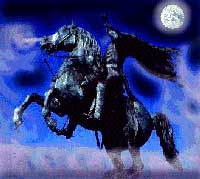
It is said that after sunset, on certain festivals and feast days, one of the most terrifying creatures in the spirit world, the Dullahan, can be seen riding a magnificent black stallion across the country side.
Wherever he stops, a mortal dies.
Clad in flowing black robes, the Dullahan has no head on his shoulders. He carries it with him in his hand, and because he is endowed with supernatural sight, he will hold the head up high. This allows him to see great distances, even on the darkest night.
But beware watching him pass by. You’ll be punished by either having a bucket of blood thrown in your face or you might be struck blind in one eye. The biggest fear of all, however, is if he stops wherever you are and calls out your name. This will draw out your soul and you’ll no longer be among the living.
Unlike the Banshee, which is known to warn of an imminent death in certain families, the Dullahan does not come to warn. He is a definite harbinger of someone’s demise and there exists no defence against him - except perhaps, an object made of gold. For some reason, the Dullahan has an irrational fear of gold and even a tiny amount may be enough to frighten him off.
One story from Galway says that a man was on his way home when all of a sudden he heard the sound of horse’s hooves pounding along the road behind him. In dread , he turned around to look. It was the Dullahan. He tried to run, but nothing can outrun the angel of death. Then the man remembered that if he couldn’t outrun him, he could outsmart him. With that, he dropped a gold coin on the road. There was a loud roar in the air, high above him, and when he turned to look again, the Dullahan was gone.
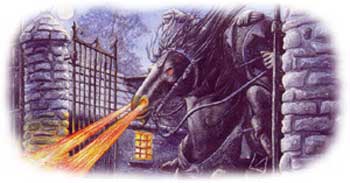
While no-one knows for certain how the Dullahan originated, it is thought that he is the embodiment of the Celtic fertility god, Crom Dubh, who was worshiped by an ancient king of Ireland, Tighermas. Each year, Tighermas sacrificed humans to Crom Dubh, and the usual method was decapitation. The worship of Crom Dubh ended in the sixth century, when Christianity came to Ireland and the old sacrificial traditions went out of favor. But Crom Dubh was not to be so easily forgotten, for it’s said that he then took on a physical form - the headless Dullahan - which means dark man - riding his mighty charger and using a human spine for a whip. And, while this is the way he is most often described, in some parts of Ireland, he drives a black coach drawn by a team of six black horses. They travel so fast that the friction from their hooves is said to set the hedges on fire along the sides of the road. And, no matter how firmly they are locked, all gates fly open to let the Dullahan through.
So, if you’re in Ireland this Hallowe’en season, be safe at home by sunset, don’t look out your window, and definitely keep a gold object close at hand!
See our other articles on Samhain and Halloween below:
An Irish Hallowe'en - Part 1
An Irish Hallowe'en - Part 2
How the Irish Invented Halloween
A Triple Treat For Hallowe'en
The Churchyard Bride
Creepy Irish Castles and Houses
Creepy Irish Creatures
Irish Ghosts
Something Wicked this way comes - Irish Ghosts by Region
Protect your property and yourself - Make a Parshell Cross for Hallowe'en
The Dullahan
Samhain - The Irish New Year
The Day after Samhain - All Souls Day
|
|
Fri, Sep 27, 2024
 The Galway Hooker The Galway Hooker
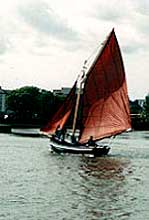
This unique vessel, with its distinctive curved lines and bright red sails, originated in the village of Claddagh. During the 19th century, hookers supported a significant fishing industry and also carried goods, livestock and fuel. Seán Rainey is remembered for building the last of the original boats, the Truelight, for Martin Oliver who was to become the last king of the Claddagh; as king, he was entitled to white sails on his boat. Since the mid seventies, many of the old sailing craft which were on the verge of extinction have been lovingly restored and new ones have been built. During the summer months they can be seen at festivals such a Cruinniú na mBád - the Gathering of the Boats - in Kinvara.
Click for More Culture Corner.
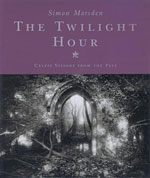
In this beautifully produced work, internationally acclaimed photographer, Simon Marsden offers haunting black and white photographs to illustrate the fictional texts borrowed from famous writers of the gothic and the macabre.
Click here for The Twilight Hour.
|
|
|
|
|