| |
Traditions, folklore, history and more. If it's Irish, it's here. Or will be!
"People will not look forward to posterity who never look backward to their ancestors."
-Edmund Burke
Quotes
Library: Books, Movies, Music
Prints & Photos
Poetry
Jokes

Shops Ireland
Bunús na Gaeilge
(Basic Irish)
Circle of Prayer
Blessings
Did You Know?
Himself/Herself
Write to Us
Readers Write..
Links/Link to Us
Advertise with us
Awards & Testimonials
Submissions Guide

Help keep us free
Throughout the site you will see many items available for purchase from well-known merchants such as Amazon. Not interested in what we're featuring? It doesn't matter. Click on any link and then shop for whatever you wish - we will still get credit, if you buy something.
Thanks for your help.
|
|
|
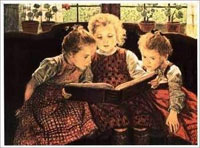 Kids' Ireland Kids' Ireland
This is a monthly column that we hope parents, grandparents, aunts, uncles or older siblings will share with children of all ages. Most are by our guest columnist, Grainne Rowland; a master spinner of stories who re-tells the tale so well they are once again fresh and new.
"There was a place in childhood that I remember well, And there a voice of sweetest tone bright fairy tales did tell."
Samuel Lover
Index of All Children's Stories
Kids' Ireland Library
The Changeling
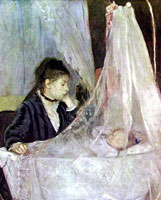 Once upon a time in Ireland, there lived a woman called Shiela. Shiela had a small baby whom she loved above all else. Once upon a time in Ireland, there lived a woman called Shiela. Shiela had a small baby whom she loved above all else.
One Saturday morning, she noticed that her baby did not look right. Her baby boy was fat, healthy, and happy. This "thing" in her baby's crib was thin and looked like a skeleton. It was ugly and had shifty eyes, not at all like Shiela's baby. This baby "thing" never stopped crying. Shiela was at wit's end. Where was her son? What was in her son's crib? And would it never stop wailing?
Shiela's neighbors came and tried to comfort her. They told her that what was in her baby's crib was certainly a changeling. She must ask the wise woman what to do.
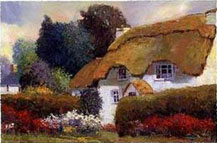
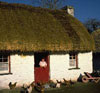
Shiela left her small thatched cottage and went along the road to the wise woman's house. But she traveled slowly because tears were pouring down her cheeks. She missed her little son and worried about him. Had the good people really taken her baby and left one of theirs in his place? Were they treating her son kindly? Would she ever see him again? These and other sad thoughts chased each other through her mind.
When Sheila was in the wise woman's house, she told the woman the whole story. The wise woman asked many questions about the baby in Sheila's cottage. Finally, after talking for two hours, the wise woman said, "Yes, you have a changeling. Here is what you must do."
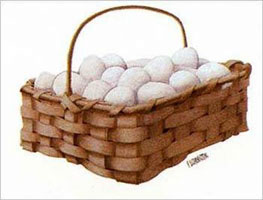
When sheila returned to her home, she hurried to her chicken house and collected a dozen eggs. Going into her house, she did not look at the changeling. Instead, she went to the hearth, started a huge, hot fire, and put on a big pot of water. When the water was boiling, Sheila broke the eggs and threw away the yolks and whites. But she kept the shells.
Sheila noticed that the changeling, for once, was very quiet. She saw from the corner of her eye that it was watching what she did very closely. But Sheila never looked at it directly.
Sheila tossed the egg shells into the boiling water.
"What are you doing, Mother?" asked the baby.
Sheila knew then that the baby was indeed a changeling, for her own son was too young to speak.
"I am brewing, my son," replied Sheila.
"What are you brewing, Mother?" asked the changeling in the creaky voice of a very old man.
"I am brewing egg shells, son," said Sheila.
"I have lived for fifteen hundred years and I have never seen anyone brew egg shells before," laughed the changeling.
At that, Sheila jumped up from the fireplace and ran toward the changeling. But she had risen so quickly that she slipped and fell. When she got up and ran to the crib, the changeling was no longer there. But there was her own dear baby, sleeping quietly and with a smile on his lips.
Sheila gently picked him up. Tears slipped down her face and dropped onto his head. But this time the tears were tears of joy!
Images:
Mother & Child in Cradle, Thatched cottage and Eggs in Basket from Allposters & Prints.
Index of All Children's Stories
Kids Reading - from All Posters
Any purchase made helps to support our site (and the Irish Culture & Customs fairytale). Thank you.
|
|
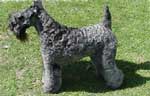 Dogs of Ireland - the Kerry Blue Terrier Dogs of Ireland - the Kerry Blue Terrier
Kerry Blue Terriers were developed over 300 years ago by Irish shepherds. Their name comes from the county of Kerry in south-western Ireland.
Gentle, lovable and intelligent they are very hard working. They can herd sheep and cattle, hunt for rats and other vermin and they are good retrievers.
When they are born, they are black. As they get older, their curly coats change to red, brown or gray and then finally to bluish-grey.
Outgoing and friendly towards their family, they are known to give big, slurpy kisses. But they are also very protective and make good guard dogs as well as excellent family pets.
Resource: Puppy Dog Web.
Click for More Culture Corner.
|
"No man ever wore a cravat as nice, as his own child's arm around his neck."
- Irish Proverb
|
|
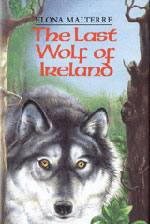
In Ireland in the 1780s, a young boy and girl who find a wolf's den in the forest vow to protect the animals from the superstitious townspeople and the greed of the hunters. Rave reviews including this one from Booklist:
"Convincing characters, tense action, and powerful conflicts makethis book an outstanding choice."
To learn more or to purchase, please click The Last Wolf in ireland.
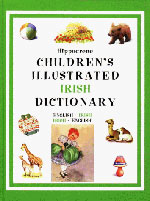
Children's Irish Dictionary
by Hippocrene Books
As a total beginner in Irish, this has taught me quite a few words. The illustrations are beautifully done, and best of all, each word is given a rough English spelling of its pronunciation. Edited from an amazon review.
Click here for Kid's Irish Dictionary.
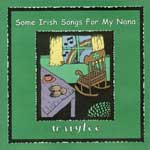
A lovely collection of well known Irish songs from the turn of the twentieth century. This album was created as a gift to MaryLee's Nana, Rose Burke Duval. The first half are songs well known to grandparents and the second half are original and traditional songs for children.
Click here for Irish Songs.
|
|
|