Custom Search
|
Custom Search
|
|
"People will not look forward to posterity who never look backward to their ancestors."
Quotes
Shops Ireland Bunús na Gaeilge Did You Know? Himself/Herself Write to Us Readers Write.. Links/Link to Us Advertise with us
Help keep us free |
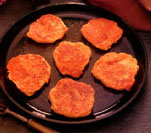
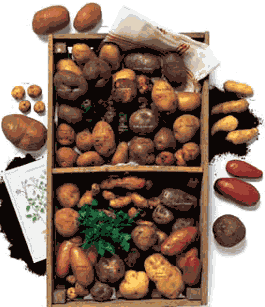
Potatoes Boxty Pancakes The following recipes serve four to six. Boxty Method: St. Paddy’s Green Potato Cakes With Pale Green Horseradish Drizzle 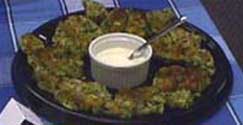  St. Patrick's Day may be long gone by, but we were delighted to learn that our resident Irish recipe collector and developer, Hartson Dowd, was just awarded first place in the "All Things Green & Yummy Contest" on the 50Plus website. So, you can tuck this one away for next year - or, better yet, why not try it now? "The Irish-American custom of serving green food on St. Patrick's Day can be taken to extremes, with most of the green coloring coming from chemical dyes, or food coloring. But this variation of those traditional Irish Potato Cakes blends in naturally green spinach with a touch of tarragon for zest. Drizzle these Irish cakes with the pale green Horseradish-Sour Cream Sauce and your family will be asking for seconds." H. Dowd Ingredients: Method: Pale Green Horseradish Drizzle Maple Sweet Potato Casserole Colcannon 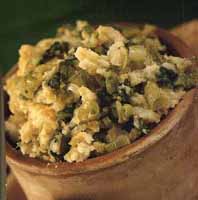 Traditionally eaten on Hallowe'en, this dish is so popular that poems have been written and songs sung in its honor. The Black Family has a really great version of the famous Colcannon song; in fact the entire CD is outstanding (See our Music Library - The Black Family). Here are the main verses: Did you ever eat Colcannon When t'was made with yellow cream, And the kale and the praties blended Like the picture in a dream? Did you ever take a forkful And dip it in the lake Of heather-flavoured butter That your mother used to make? While there are a number of ways to make it - some made with kale, some with a combination of both, and some with cabbage, we like the one that follows which is adapted from Darina Allen's Festive Foods of Ireland cookbook. Ingredients: 2-2 1/2 lbs of floury potatoes 1 small head of green cabbage 1 cup milk 2 or more tablespoons chopped green onions 1/2 stick butter Salt and pepper to taste Method: 1. Scrub potatoes and leave skins on. Place in cold water with a generous pinch of salt, cover and bring to a boil. 2. When the potatoes are about half done, (about 15 minutes), strain off two thirds of the water. Replace lid and place on a gentle heat and allow potatoes to steam until they are cooked. 3. Discard the dark outer leaves of the cabbage. Wash the rest and cut into quarters; remove the core and cut finely across the grain. Cook in a little boiling salted water until soft. Drain, then season with salt and pepper and a little of the butter. 4. When the potatoes are cooked, put the milk into saucepan with the green onions and bring to the boil. Pull the skins off the potatoes, mash quickly and beat in enough of the hot milk to make a fluffy purée. 5. Stir in the cooked cabbage and taste for seasoning. 6. Serve in a heated dish; make a well in the center and add the remaining butter. Note: Today, many an Irish mother persuades her children to eat their colcannon by wrapping coins in heat-proof paper and hiding them in the dish; in the old days, the rural folk often placed a wedding ring in the colcannon; the first single person to get the ring would marry within the year. It was also customary, before going to bed on Hallowe'en, to put out a plateful of colcannon with a lump of butter in the center for the fairies and the ghosts. For another traditional Halloween treat, please click Barmbrack. 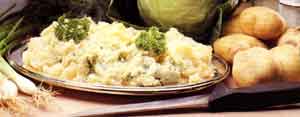 Champ: A Traditional Alternative to Colcannon Champ: A Traditional Alternative to Colcannonby Bridget Haggerty While Colcannon is most-often mentioned when considering a menu for Hallowe'en, Champ is just as authentic. The main difference is the substitution of scallions or other greens for the kale or cabbage. In her fascinating book, The Cookin' Woman*, Florence Irwin gives no less than five versions of this dish - Champ made with nettles, chives, parsley, peas, as well as scallions. She concludes her recipes with the following observation: "The main thing about Champ is it must be kept very hot while being made and served on very hot plates, and accompanied with good butter, and milk or buttermilk to drink." In contemporary Irish cookbooks, both Colcannon and Champ are often relegated to the realms of side-dishes, but in the old tomes, such as Irwin's work, they're meals in themselves. That comes as no surprise to this writer. On a dreary, often damp and cold evening in Ireland, nothing surpasses either Champ or Colcannon for comfort food at its best. Of course, you can also get a bit fancy and add other ingredients. Ms. Irwin follows the main recipes with Champ and Scrambled Eggs, as well as Champ and Poached Eggs. "Make a "dunt" in the center of the potatoes and place the eggs in the hole." For an even more elaborate version with the poached eggs, we suggest sprinkling the dish with grated sharp cheese and broiling it until the cheese is melted and the potatoes are crusty and flecked with brown. Served with Irish pork sausages or rashers of bacon and you have not just a meal but a banquet! Ingredients: Serves 2 as a meal or 4 as a side dish 1-1/2 lbs. potatoes Greens for flavoring About 1 cup milk Salt and black pepper Method: 1. Peel the potatoes and set in a pot with a tight lid. Mix a half teaspoon of salt into a cup of water and pour over the potatoes. Bring to a boil, lower the heat until the water's simmering, and cook for about twenty minutes, or until the water is gone and the potatoes are cooked through. Experience will teach the exact amount of water to use; the trick is to catch the potatoes just before they scorch. 2. Meanwhile, prepare the milk and greens mixture. Scallions: 1 bunch (6 to 8), minced, including the part of the green that isn't wilted or damaged. While those who love scallions can mash them into the potatoes uncooked in the traditional Irish fashion, Irwin suggests that anyone bothered by their acrid aftertaste (and digestive effects) not only cook them in the milk but first put them into a bowl, sprinkle them with a little salt, and pour boiling water onto them. Drain this away and add the scalded scallion bits to the milk. Bring this just to a simmer and hold it there for five minutes until the flavour has suffused through the milk. Chive: One quarter cup, minced. Again, these are traditionally beaten into the potatoes uncooked, but those who would like them a little tamer should simmer them in the milk for five minutes before working the mixture into the potatoes. Peas. One cup baby peas. Cook in the milk until tender, about six minutes. Then, as you prefer, either mash these into the champ with the milk or strain out and reserve to be stirred in whole just before serving. Parsley. A quarter cup, finely minced. Heat for three minutes in the milk and proceed. Nettles. Choose only the tender tops; wash and chop finely. Simmer for ten minutes in the milk. 3. When the potatoes are ready, mash them by hand until they are smooth. Then, over the heat so that the champ remains piping hot, work in the milk and greens mixture. The consistency should be thick but creamy - add more milk if necessary. Season well with salt and black pepper. Eat your bowl of champ with plenty of fresh butter (Irish, if possible) and wash it down with a tall glass of cold buttermilk. NOTE: The Cookin' Woman: Irish Country Recipes by Florence Irwin is out of print but we did find copies available in amazon's marketplace. For more on the potato and more recipes click Potatoes 2. |
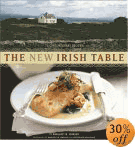
The New Irish Table Margaret Johnson’s love of Ireland permeates page after glorious page of mouthwatering Irish dishes, from Smoked Salmon Chowder to Raspberry Buttermilk Tarts. Lavish color photographs of the food, the landscapes, and the people are woven through the text, making The New Irish Table the next best thing to sitting down to dinner in Ireland itself.
|
||||||||||||||
|
||||||||||||||||
| All contents copyright © 2001 through 2011 inclusive - all rights reserved. March 4, 2011 |
|
|
||||||||||||||