

Custom Search
|
Custom Search
|
 |
|
"People will not look forward to posterity who never look backward to their ancestors."
Quotes
Shops Ireland Bunús na Gaeilge Did You Know? Himself/Herself Write to Us Readers Write.. Links/Link to Us Advertise with us Awards & Testimonials
|
The May Day Dew - Should you roll naked in it? "The English women and gentlewomen in Ireland, as in England, did use in the beginning of the summer to gather good store of dew, to keep it by them all the year after for several good uses both of physick and otherwise. Their manner of collecting and keeping it was this. In the month of May especially, and also in part of the month of June, they would go forth betimes in the morning, and before sun-rising, into a green field, and there either with their hands strike off the dew from the tops of the the herbs into a dish, or else throwing clean linnnen cloaths upon the ground, take off the dew from the herbs into them, and afterwards wring it out into dishes: and thus they continue their work until they have got a sufficient quantity of dew according to their intentions. That which is gotten from the grass will serve, but they chuse rather to have it from the green corn, especially wheat, if they can have the convenience to do so, as being persuaded that this dew hath more vertues and is better for all purposes than that which hath been collected from the grass or other herbs. The dew thus gathered they put in a glass bottle and so set it in a place where it may have the warm sunshine all day long, keeping it there all the summer; after some days rest some dregs and dirt will settle to the bottom; the which when they perceive, they pour off all the clear dew into another vessel, and fling away those settings. This they do often as those good women see any notable quantity; they still pour off the the clear dew from them: doing thus al summer long, until it be clear to the bottom. The dew thus thoroughly purified looketh whitish, and keepeth good for a year or two after." In another (May the month of mirth and merriment) article, we posed a riddle: I washed my face in water When we published this article, of all the answers we received, Audrey, Judith and Tina came closest, but not quite close enough. This year Deiridh sent us the correct answer. Not to leave it there, she gave us another riddle: |
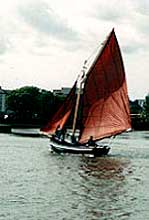 The Galway Hooker The Galway Hooker
This unique vessel, with its distinctive curved lines and bright red sails, originated in the village of Claddagh. During the 19th century, hookers supported a significant fishing industry and also carried goods, livestock and fuel. Seán Rainey is remembered for building the last of the original boats, the Truelight, for Martin Oliver who was to become the last king of the Claddagh; as king, he was entitled to white sails on his boat. Since the mid seventies, many of the old sailing craft which were on the verge of extinction have been lovingly restored and new ones have been built. During the summer months they can be seen at festivals such a Cruinniú na mBád - the Gathering of the Boats - in Kinvara. |
||||||
|
||||||||
| All contents copyright © 2001 through 2011 inclusive - all rights reserved. March 4, 2011 |
Rollover button Images: Wedding LaRose, Kids Reading & Kitchen Apples and Tea from All Posters prints. The information provided on this site is offered as-is, without warranty. This site's owners, operators, authors and partners disclaim any and all liability from the information provided herein. Any trademarks or registered trademarks on this site are the property of their respective owners. |
This Web Site Bashed, Kicked & Glued together by Russ Haggerty. |
||||||








 The plainest girl will be beautiful if she rises early on May Day and bathes her face in morning dew at sunrise. So goes the old Irish saying...