| |
Traditions, folklore, history and more. If it's Irish, it's here. Or will be!
"People will not look forward to posterity who never look backward to their ancestors."
-Edmund Burke
Quotes
Library: Books, Movies, Music
Prints & Photos
Poetry
Jokes
Shops Ireland
Bunús na Gaeilge
(Basic Irish)
Circle of Prayer
Blessings
Did You Know?
Himself/Herself
Write to Us
Readers Write..
Links/Link to Us
Advertise with us
Awards & Testimonials
Submissions Guide

|
|
|
Emblems of Ireland: The Harp
by Bridget Haggerty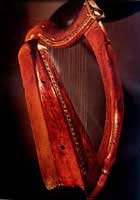
It once graced the flag of the Republic, it still appears on official government documents as well as the Presidential flag, and it is displayed on Irish coins. For centuries, the harp has been a beloved emblem of Ireland. In fact, it is said that the Irish concentrated so much of their musical ability into playing the harp, that for many years, the development of music in Ireland was brought to a relative standstill.
So, how did the harp become an emblem synonymous with the Emerald Isle? According to tradition, an early king of Ireland whose name was David, took the harp of the Psalmist as his badge. This might explain why it was once called a cruit which can mean lyre.
Folklore says that the first harp was owned by Dagda, a chief among the Tuatha De Danaan. The De Danaan were at war with the Fomorians and the harp was taken from Dagda by the gods of cold and darkness. Two other gods, Lugh representing light, and Ogma representing art, penetrated the Fomorian fortress, recovered the harp and restored it to Dagda. The gods in returning the harp to him, pronounced two secret names for the instrument and, at the same time, called forth summer and winter. From that point on, when Dagda played, he could produce a melody so poignant, it would make his audience weep, an air so jubilant it would make everyone smile, or a sound so tranquil, it would lull all who listened to sleep. Thus, with its secret or magical names, the instrument became the dispenser of Sorrow, Gladness and Rest.
Whichever way the harp became Ireland's own unique instrument, and subsequently, its national emblem, history tells us that the people who played it were highly trained professionals who usually performed for the nobility. They were held in very high regard and were often asked to accompany a bardic poet who was giving a reading. However, with the emigration of Ireland's leading families in the 17th and early 18th century, there was a steep decline in the harping tradition and the last traditionally-trained harpist died in the mid-19th century. Interestingly, these superb musicians played with their fingernails and not with the flesh of the fingertips as is done today. It's also interesting to note that new families of English descent were hospitable to well-known harpists such as O'Carolan, and it was a man from the north, Dr. Michael MacDonnell, and an Englishman, Edward Bunting, who assembled the last harpers in Belfast in 1792. Even though very generous fees were offered, they were able to attract only 11 players from the whole country. Bunting attempted to write down as much of the music as he could and his collection is incredibly important because it contains the only remaining remnants of what the ancient tradition must have been like.
So, while this oldest emblem of Ireland is still very much apparent - even to appearing on the Guinness label - most of the ancient airs and melodies it once produced are long gone. Perhaps the first verse of a famous poem by Thomas Moore says it best:
"The harp that once through Tara's halls the soul of music shed,
now hangs as mute on Tara's walls, as if that soul were fled.
So sleeps the pride of former days,
so glory's thrill is o'er,
and hearts that once beat high for praise,
now feel that pulse no more."
|
|
Thu, Apr 4, 2024
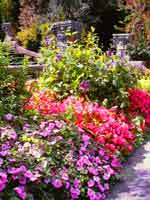 Ilnacullen, Co. Cork - an Island Garden Ilnacullen, Co. Cork - an Island Garden
Located in the sheltered harbour of Glengarriff in Bantry Bay. Ilnacullin, which means island of holly, is a small island known to horticulturists and lovers of trees and shrubs all around the world as an island garden of rare beauty.
The vivid colours of Rhododendrons and Azaleas reach their peak during May and June, whilst the hundreds of cultivars of climbing plants, herbaceous perennials and choice shrubs dominate the midsummer period from June to August.
Because of its sheltered situation and the warming oceanic influence of the Gulf Stream, the climate is favourable to the growth of ornamental plants from many parts of the world.
Even for those who aren’t particularly interested in gardens, there are many other scenic views, especially in the surrounding waters where seals frequent the rocks on the southern shore.
The cover photo on Bridget's book The Traditional Irish Wedding shows a wrought iron garden gate on Ilnaculen. I took that photo. To see it, go to the home page. It's part of the opening paragraph Failte.
—Russ
Resource: Copy and Image - Cork Guide
Click for More Culture Corner.
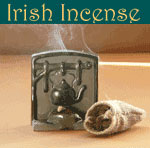
Love the aroma of a turf fire? Experience the next best thing with Irish Incense, the peaceful, nostalgic scent that will transport you back in time and place. The perfect gift for Christmas or any other occasion, order now. A special offer for Irish Culture and Customs visitors: 10% discount on all
products! Just enter the Coupon Code ICC200 in the Check out section of
the web site.
Click here for Irish Incense.
|
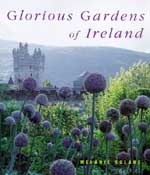
A magnificent pictorial tribute to the splendor of Irish gardens, featuring more than 200 color images.
Eclare ushers readers into spectacular Irish garden settings...
Equally captivating are the book's gorgeous photographs of plants, beautiful stonework, outstanding statuary, and the voluptuous floral compositions that adorn Ireland's great castle estates, rural herb growers, country guest houses, and quaint cottages.
Alice Joyce
Click for Glorious Gardens.
|
|
|
|
|