| |
Traditions, folklore, history and more. If it's Irish, it's here. Or will be!
"People will not look forward to posterity who never look backward to their ancestors."
-Edmund Burke
Quotes
Library: Books, Movies, Music
Prints & Photos
Poetry
Jokes
Shops Ireland
Bunús na Gaeilge
(Basic Irish)
Circle of Prayer
Blessings
Did You Know?
Himself/Herself
Write to Us
Readers Write..
Links/Link to Us
Advertise with us
Awards & Testimonials
Submissions Guide

|
|
|
Emblems of Ireland:The Book of Kells
by Michael Carroll
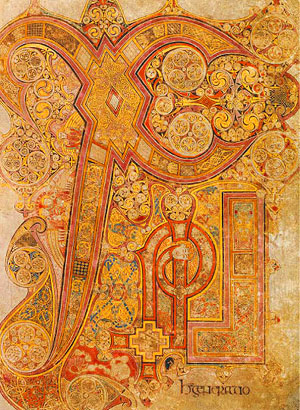 Almost as synonymous with the Emerald Isle as St. Patrick and the Shamrock, The Book of Kells is probably the most famous example of medieval illumination and calligraphy still in existence. Guest author, Michael Carroll, has uncovered some fascinating facts about this national treasure. For example, did you know that the book was written and decorated not by one hand, but several?
Scholars have detected the work of at least three different artists, who may or may not have been the calligraphers as well. Subtle variation in the lettering reveals something of the personality of each individual scribe. One seems to have preferred rounded letterforms written in a dignified hand, while another left evidence of his extroverted nature in his use of brilliant red ink and flamboyant pen flourishes.
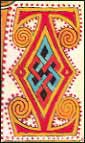 he Book of Kells, The Book of Durrow, The Lindisfarne Gospels and other Celtic manuscripts were written and decorated entirely by natural daylight. According to Marc Drogin in Medieval Calligraphy (Dover Books) the monasteries were so fearful of accidental fire that the use of candles or oil lamps was forbidden inside the scriptoriums (writing rooms) and libraries. The scribe worked from dawn till dusk, stopping only for prayer and meals or his turn at the hoe, working in the fields alongside his brethren. he Book of Kells, The Book of Durrow, The Lindisfarne Gospels and other Celtic manuscripts were written and decorated entirely by natural daylight. According to Marc Drogin in Medieval Calligraphy (Dover Books) the monasteries were so fearful of accidental fire that the use of candles or oil lamps was forbidden inside the scriptoriums (writing rooms) and libraries. The scribe worked from dawn till dusk, stopping only for prayer and meals or his turn at the hoe, working in the fields alongside his brethren.
The use of small red dots in Celtic manuscripts does not (contrary to some modern interpretations) represent the "universal life force", but was in fact a decorative device.
The technique, known to calligraphers as rubrication, was borrowed by the Celtic monks from Egyptian Coptic Christian manuscripts brought to Ireland by missionaries in the 5th century. The small red dots were used to outline large initials or to make a particular line of text stand out from the page. In later years, Celtic artists elevated the humble red dot into a high art form, creating complex webs of delicate knotwork and even animal interlace.
Before St. Patrick introduced books along with Christianity to Ireland, the Irish had no useful written language.
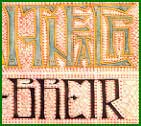
Ogham, a primitive system of slashes and dots, was used to inscribe names on gravesites and standing stones, but proved too cumbersome for everyday use. So, when the Roman alphabet was introduced in the fifth century, the Irish embraced it as their own, and even adapted it for the Gaelic tongue to record their ancient myths and legends.
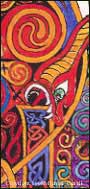 The production of a single copy of the Four Gospels such as The Book of Kells required that the monks keep a herd of as many as 1200 cattle, which also provided food and milk for the monastery. It has been estimated that The Book of Kells originally was written on the skins of about 185 animals. Paper being then unknown, this parchment was their only source of writing material.
The monks who labored daily over their writing tables, endlessly copying out page after page of text, some of which they could barely translate, often grew fatigued and made errors. Just as modern calligraphers do, the scribes occasionally repeated a word or line, made a spelling mistake, and did not notice the error. In The Book of Kells there are numerous places where the red ink of the editor made later corrections to the Latin text. After a day's work was done, the young scribes often penned short notes, prayers or poems in tiny script in the margins. One later scribe finished copying out a text, describing it as: "...very long, very verbose, and very tedious for the scribe."
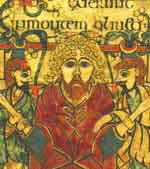
We are very grateful to Mr. Carroll for this contribution and we hope you will visit his beautiful web site. Celtic Design.
|
|
Thu, Apr 4, 2024
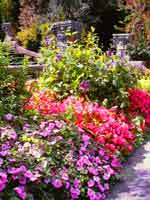 Ilnacullen, Co. Cork - an Island Garden Ilnacullen, Co. Cork - an Island Garden
Located in the sheltered harbour of Glengarriff in Bantry Bay. Ilnacullin, which means island of holly, is a small island known to horticulturists and lovers of trees and shrubs all around the world as an island garden of rare beauty.
The vivid colours of Rhododendrons and Azaleas reach their peak during May and June, whilst the hundreds of cultivars of climbing plants, herbaceous perennials and choice shrubs dominate the midsummer period from June to August.
Because of its sheltered situation and the warming oceanic influence of the Gulf Stream, the climate is favourable to the growth of ornamental plants from many parts of the world.
Even for those who aren’t particularly interested in gardens, there are many other scenic views, especially in the surrounding waters where seals frequent the rocks on the southern shore.
The cover photo on Bridget's book The Traditional Irish Wedding shows a wrought iron garden gate on Ilnaculen. I took that photo. To see it, go to the home page. It's part of the opening paragraph Failte.
—Russ
Resource: Copy and Image - Cork Guide
Click for More Culture Corner.
|
The Book of Kells
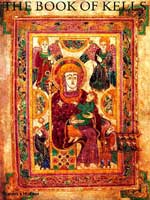
Over 100 color illustrations, dozens of enlargements, and commentary by the Keeper of Manuscripts at Trinity College make this book a bargain at twice the amazingly low price.
Click for the Book of Kells
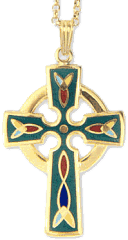
Gold plated and richly enhanced with design elements from illuminations in Ireland's most treasured manuscript.
Click here for Kells Cross.
|
|
|