| |

Traditions, folklore, history and more. If it's Irish, it's here. Or will be!
"People will not look forward to posterity who never look backward to their ancestors."
-Edmund Burke



Quotes
Library: Books, Movies, Music
Prints & Photos
Poetry
Jokes

Shops Ireland
Bunús na Gaeilge
(Basic Irish)
Circle of Prayer
Blessings
Did You Know?
Himself/Herself
Write to Us
Readers Write..
Links/Link to Us
Advertise with us
Awards & Testimonials
Submissions Guide


|
|
|
The Borrowed Days
 Edited and adapted by Bridget Haggerty Edited and adapted by Bridget Haggerty
According to the old story 'An tSean-Bhó Riabhach' , the old brindled cow boasted that even the rigours of March could not kill her, whereupon March borrowed three days from April and using these with redoubled fury, killed and skinned the poor old cow. Henceforth, the first three days of April traditionally bring very bad weather and are known as as Laethanta na Riabhaiche, The Reehy Days, the Borrowed or Borrowing Days, the Skinning Days, and other names.
Some people reckoned the days in the Old Style, thus Amnhhlaoibh O Súlleabháin wrote the following in 1827:
"This the 12th day of April, is the first of the three days of the old brindled cow, namely three days in which the weather of March took from the beginning of Old April.'
An old ballad tells how capricious March begged generous April for a loan and then rendered the three days awful:
The first of them was wind and wet,
The second of them was snow and sleet,
The third of them was such a freeze,
It froze the birds' claws to the trees.
In parts of Northern Ireland, the story was more elaborate with nine borrowed days instead of three. The old legend states that the blackbird, the stone-chatter and the old grey cow bid defiance to March after his days were done and that to punish their insolence, he begged of April nine of his days, three for each of them for which he repaid nine of his own:
Trí lá lomartha an loinn
Three days for fleecing the black-bird,
Three days of punishment for the stone chatter,
Trí lá sgiuthanta an chlaibhreáin
Agus trí lá na bó riabhaighte
And three days for the grey cow.
Superstitions surrounding the "borrowed days" endured well into the nineteenth century and throughout the British Isles. They were dangerous days, fraught with taboos and the spectre of bad weather. After King James I died at the tail end of March during a storm that battered the Scottish coast, a contemporary writer mourned that this would be " long after remembered as the storm of the Borrowed Days." An earlier document, titled Complaint of Scotland, laments that "the boreal blasts of the three borrowing days of March had chased the fragrant flowers of every fruit-tree far athwart the fields."
Sources:
Encyclopaedia of the Celts
The Year in Ireland by Kevin Danaher
Ulster Journal of Archaeology. 1861-2.225
Image:
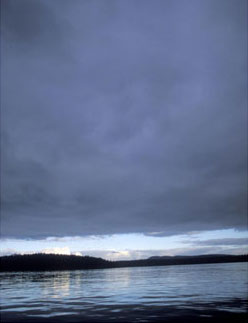
Stormy Sky Over Lake by FogStock from All Posters prints
|
|
Fri, Sep 27, 2024
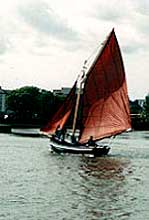 The Galway Hooker The Galway Hooker
This unique vessel, with its distinctive curved lines and bright red sails, originated in the village of Claddagh. During the 19th century, hookers supported a significant fishing industry and also carried goods, livestock and fuel. Seán Rainey is remembered for building the last of the original boats, the Truelight, for Martin Oliver who was to become the last king of the Claddagh; as king, he was entitled to white sails on his boat. Since the mid seventies, many of the old sailing craft which were on the verge of extinction have been lovingly restored and new ones have been built. During the summer months they can be seen at festivals such a Cruinniú na mBád - the Gathering of the Boats - in Kinvara.
Click for More Culture Corner.
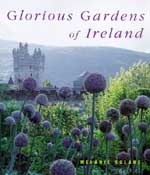
A magnificent pictorial tribute to the splendor of Irish gardens, featuring more than 200 color images.
Eclare ushers readers into spectacular Irish garden settings...
Equally captivating are the book's gorgeous photographs of plants, beautiful stonework, outstanding statuary, and the voluptuous floral compositions that adorn Ireland's great castle estates, rural herb growers, country guest houses, and quaint cottages.
Alice Joyce
Click for Glorious Gardens.
|
|
|
|
|