| |
Traditions, folklore, history and more. If it's Irish, it's here. Or will be!
"People will not look forward to posterity who never look backward to their ancestors."
-Edmund Burke
Quotes
Library: Books, Movies, Music
Prints & Photos
Poetry
Jokes
Shops Ireland
Bunús na Gaeilge
(Basic Irish)
Circle of Prayer
Blessings
Did You Know?
Himself/Herself
Write to Us
Readers Write..
Links/Link to Us
Advertise with us
Awards & Testimonials
Submissions Guide

|
|
|
Lughnasa - Celebrating the Harvest
by Bridget Haggerty
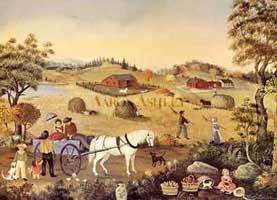
Traditionally, August marked the beginning of the Harvest season and it was a time of great celebration in rural Ireland.
The season began on the first of the month with the festival of Lughnasa, the Irish word for August. Since it was impractical to take farm folk away from their work during the week, it was generally celebrated on the first or second weekend. The weather was usually fine and it was traditional for entire communities to gather at a chosen meeting place in the hills, by a river or lake, or perhaps at a holy well. Of the four great Celtic festivals - Imbolc, Beltane and Samhaine, Lugnasa was the most joyeous because, after 'Hungry July', when stores were being rapidly depleted, farm folk could look forward to the fruits of all their hard work during the previous months.
 As with May Day, whose name Beltane comes from the old Celtic God, Belenos, the pre-Christian name Lugnasa comes from the god of craftsmanship and wisdom, Lugh. When christianity came to Ireland and the other Celtic nations, the festival became known as Lammas or 'first loaf' and it was customary to bake a special loaf of bread from the first corn. In medieval times, these first loaves were laid on altars as offerings, but it was also the custom to eat them at a celebratory feast which might also include the first of the newly-dug potatoes. These were boiled in a big black three-legged iron pot over an open fire and eaten with plenty of freshly churned butter, or mashed with boiled cabbage, leeks, scallions or wild garlic. Yet another welcome feature of the feast was fresh fruit. It was very common for rural folk to have currants or gooseberries in their gardens, and for those living in the hills, there was the delight of adding freshly picked and intensely flavored fraughans or wild blueberries to the menu. These were mashed with fresh cream and sugar and eaten with great relish. But, however delicious the feast was, it was not the main event. What everyone looked forward to was the traditional annual excursion to a favorite gathering place. As with May Day, whose name Beltane comes from the old Celtic God, Belenos, the pre-Christian name Lugnasa comes from the god of craftsmanship and wisdom, Lugh. When christianity came to Ireland and the other Celtic nations, the festival became known as Lammas or 'first loaf' and it was customary to bake a special loaf of bread from the first corn. In medieval times, these first loaves were laid on altars as offerings, but it was also the custom to eat them at a celebratory feast which might also include the first of the newly-dug potatoes. These were boiled in a big black three-legged iron pot over an open fire and eaten with plenty of freshly churned butter, or mashed with boiled cabbage, leeks, scallions or wild garlic. Yet another welcome feature of the feast was fresh fruit. It was very common for rural folk to have currants or gooseberries in their gardens, and for those living in the hills, there was the delight of adding freshly picked and intensely flavored fraughans or wild blueberries to the menu. These were mashed with fresh cream and sugar and eaten with great relish. But, however delicious the feast was, it was not the main event. What everyone looked forward to was the traditional annual excursion to a favorite gathering place.
The festivities began early in the morning so the participants could 'make a day of it'; they set out on foot, on horseback or in carts, and made sure to bring plenty of food, drink as well as musical instruments. On arrival at the meeting place, festivities began in earnest. There'd be the young men engaged in tests of skill and strength as well as sport and games. There's even historic documentation that if there was a body of water nearby, they'd hold horse swimming races! The young girls picked wild flowers and made them into garlands or nosegays. If there was a sacred standing stone in the area, it would often be decorated with garlands of flowers. And, of course, there were always the wild berries to be picked and savored on the spot or saved for dessert.
 Before and after the feast, there would be singing, dancing and story-telling, and as afternoon turned to dusk, bonfires would be lit and the merry-making would continue. Children engaged in games of Leap Frog and rounders which is a precursor to softball or baseball, the old ones gossiped and amused themselves watching the young folk, and all in all, it was a day of fun and frivolity for every participant. All, except perhaps, the farm animals. Before and after the feast, there would be singing, dancing and story-telling, and as afternoon turned to dusk, bonfires would be lit and the merry-making would continue. Children engaged in games of Leap Frog and rounders which is a precursor to softball or baseball, the old ones gossiped and amused themselves watching the young folk, and all in all, it was a day of fun and frivolity for every participant. All, except perhaps, the farm animals.
In some parts of Ireland, it was customary on the first Sunday in August to drive horses and cattle into a pool or river and "swim them". This was done as a health measure and was considered so important that if the farmer neglected his duty, the animal would not survive the year. This might explain the swimming races mentioned earlier! In addition to the custom of "drenching", country folk would also attempt to ward off evil by throwing a horse's bridle into the water and leaving it there. In the case of cattle, the custom was to throw in a lump of butter so that the cows would produce plenty of milk.
Besides the gatherings of entire communities, there were other Lugnasa customs and traditions. This was a favorite time for "pattern days" which were when a favorite saint or patron saint was honored with a visit to their sacred well or shrine. Festivities began with devotions which consisted of "making the rounds." The faithful would walk around the shrine or well a certain number of times while reciting special prayers. If the pattern was held at a sacred well, part of the ritual included drinking the water or, if one had a sore or other affliction, washing that part of the body in the sacred stream. Many shrines and wells are famous for their cures of various ailments. In general, most pilgrims left a small token of their visit - a coin perhaps, or a piece of cloth hung up. After the devotions, the secular festivities began and these were very similar to the Harvest celebrations already mentioned.
Superstitions, especially about the weather, also played a prominent role during Lughnasa. In Co. Limerick, for example, Knockfeerina Mountain was a weather portent over a wide area. If the peak looked blue and distant, a fine harvest was expected; if it appeared green and close at hand, the worst was feared. Also, it was widely believed that if floods occur in May, flooding could be expected during harvest time. In general, the many beliefs and traditions which heralded the season evolved from its supreme importance to the lives of the people and their survival. Thus, there were offerings of fruits and flowers on Knnockfeerina Mountain as well as the garlanding with flowers of the largest pillar stone - all to ensure plenty in the coming year, and all undoubtedly, remnants of rituals that go back way before Christianity.
One August event, with its attendant rites and rituals has survived to the present day, and that's the Puck Fair in Killorglin, Co. Kerry.
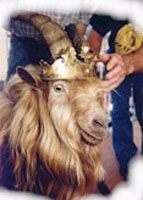
The fair is one of Ireland's oldest and longest celebrated and is held without fail on the10th,11th and 12th of August every year. There is such a wealth of material surrounding this event that it properly deserves its own article, so look for that one later in the week. What can be said about the old fairs is that August was one of the most favorite times to hold them. The biggest ones attracted kings and nobles, foreign merchants, musicians, entertainers and throngs of people, many of them looking to buy and sell livestock or hire themselves out for the coming year. One historical record states that at a major fair held in 1168, there was a traffic jam of horses and vehicles six miles long!
Before we leave the celebration of the harvest, we can't overlook two other feast days that were very important in the Irish calendar - Féile Mhuire 'sa bhFomhar, The Festival of Our Lady in the Harvest. This was held on August 15th and is more commonly known as The Feast of The Assumption - a holy day of obligation. The other one is St. Bartholomew's Day on August 24, which was a holy day of obligation until 1778.
The Feast of The Assumption
Taking place as it did during the farmer's busiest season, and also when the weather was fair, gave a double opportunity for families to enjoy some rest and relaxation. If they lived within easy reach of the coast, it was customary to take a trip to the beach and many people believed that a bathe in the sea on this day was especially beneficial to health. People also thought that it was a good idea to drink three mouthfuls of sea water which was famed as a mild laxative. Supposedly, one could distinguish between those who were "day-trippers" and those who were staying for several days by the way visitors greeted each other. On the first day, they asked "Have you drunk it?" On subsequent days - "has it worked?"
St. Bartholomew's Day
This festival was somewhat of a landmark for the corn growers because the harvest should have been well advanced by this date. Traditionally, this was the day when flails were ready to thresh the harvest. High winds are injurious to ripe corn and if one came up at this time, it was said to be "Beairlí na Gaothe" - Bartholomew of the Wind" - preparing his flail to thresh the corn still standing in a laggard's fields.
Note: Corn in this context is a term used to describe all four of the main cereal crops grown in Ireland - wheat, oats, barley and rye.
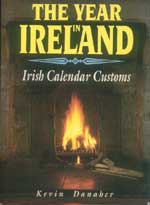
Resources: The Year In Ireland by Kevin Danaher, Old Days, Old Ways by Olive Sharkey, and The Festive Foods of Ireland by Darina Allen.
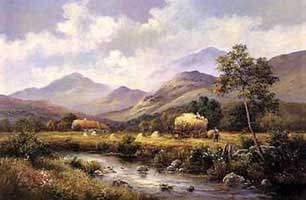
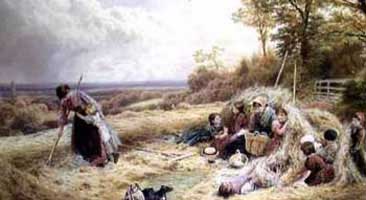
Images: Harvest by Martha Cahoon, Full Harvest by Wendy Reeves and Harvest Time by Myles Birket Foster from All Posters and Prints.
|
|
Thu, Apr 4, 2024
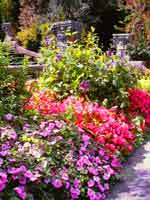 Ilnacullen, Co. Cork - an Island Garden Ilnacullen, Co. Cork - an Island Garden
Located in the sheltered harbour of Glengarriff in Bantry Bay. Ilnacullin, which means island of holly, is a small island known to horticulturists and lovers of trees and shrubs all around the world as an island garden of rare beauty.
The vivid colours of Rhododendrons and Azaleas reach their peak during May and June, whilst the hundreds of cultivars of climbing plants, herbaceous perennials and choice shrubs dominate the midsummer period from June to August.
Because of its sheltered situation and the warming oceanic influence of the Gulf Stream, the climate is favourable to the growth of ornamental plants from many parts of the world.
Even for those who aren’t particularly interested in gardens, there are many other scenic views, especially in the surrounding waters where seals frequent the rocks on the southern shore.
The cover photo on Bridget's book The Traditional Irish Wedding shows a wrought iron garden gate on Ilnaculen. I took that photo. To see it, go to the home page. It's part of the opening paragraph Failte.
—Russ
Resource: Copy and Image - Cork Guide
Click for More Culture Corner.
This great classic of Irish folklore is one of Bridget's "bibles."
In his warm, easy-going style, we are introduced to the old ways if life; we learn how a roof is thatched, what the people wore, what they ate and drank (inluding a whole chapter devoted to mountain dew), the importance of the dairy, the customs associated with weddings and wakes, how young people were educated, and more.. It's fascinating and absorbing reading - and once you get started, it's difficult to put down.
Click here for Ireland Long Ago.
|
|
|
|
|