| |


Traditions, folklore, history and more. If it's Irish, it's here. Or will be!
"People will not look forward to posterity who never look backward to their ancestors."
-Edmund Burke


Quotes
Library: Books, Movies, Music
Prints & Photos
Poetry
Jokes


Shops Ireland
Bunús na Gaeilge
(Basic Irish)
Circle of Prayer
Blessings
Trivia Contest
Did You Know?
Himself/Herself
Write to Us
Readers Write..
Links/Link to Us
Advertise with us
Awards & Testimonials
Submissions Guide

|
|
|
Watching the weather on St. Swithin's Day
by Bridget Haggerty
St Swithins Day, if it does rain
Full forty days, it will remain
St Swithins Day, if it be fair
For forty days, t'will rain no more."
This charming weather-rhyme is well known throughout the British Isles and Ireland. St. Swithin was an early Saxon Bishop of Winchester and legend says that as he lay on his deathbed, he asked to be buried in the common graveyard, "where the rain would fall on him and the feet of ordinary men could pass over him." For nine years, his wishes were followed, but then, the monks of Winchester attempted to remove his remains to a splendid shrine.
The work began on July 15th, but it couldn't be finished then, or for many years afterwards. Torrential rains prevented it on the first day and these continued for forty days and forty nights. It was said that St. Swithin, who had detested any outward display or ostentation, was weeping in protest.
The countryside was flooded and the monks beseeched St. Swithin to intercede for them. It's said that he appeared to one of his monks and revealed to him how displeasing it was to God to spend their time in useless expenditures of time and money which might easily be spent with more advantage in the relief of the poor and needy; he also forbade the monks to ever interfere with his remains thereafter.
In AD 963, the work on the mausoleum was finally completed, but, by then, the legend of St. Swithin as a rain-saint was firmly established. The legend made its way to Ireland during the middle ages and the following passage, which appeared on August 22, 1942 in the Longford Leader, shows that the belief is long-lived:
"St. Swithin's Day has rather justified the reputation of its weather forecast this year, and now everybody is looking forward anxiously to the fortieth day in the hope that new conditions of weather will result. When it rained on St. Swithen's Day the incredulous smiled in sympathy with believers in the tradition. Today if they smile it is in anticipation of the end of a dreary forty days which is expected during the coming week - if it is punctual, as it has been in other respects, the changed conditions should arrive by Monday."
Oddly enough, while most of us would rather not see rain on July 15th, apple-growers hope for it on this day, as well as on the feast of Sts. Peter and Paul (June 29) for it is believed that the saints are watering the crops. If they fail to do so, the apple-crop will be a poor one. Furthermore, no apple should picked or eaten before July 15th and all apples growing at this time will ripen.
Since we don't have an apple orchard, we're not worried about a lack of rain. Wherever you are, if you are hoping to be drenched with sunshine, we pray it will be so. On the other hand, if you're in an area of drought, may you be blessed with a wet St. Swithins!
Resources: The Year in Ireland by Kevin Danaher, The Perpetual Almanac of Folklore by Charles Kightly and Encyclopedia of Superstitions by Christina Hole.
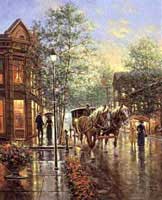
Images: April in Old Aspen by Jack Terry from All Posters and Prints.
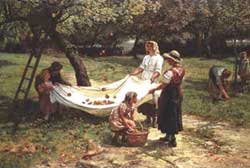
Apple Gathering by Frederick Morgan from Barewalls Prints.
|
|
Thu, Mar 27, 2008

Irish Furze
Called whin in the north and gorse in the east, furze was once a symbol of wealth and fertility of land as is emphasized by the saying: "gold under furze, silver under rushes and famine under heather."
As indigenous to the early summer landscape as rhododendrons, it is despised by farmers because of its invasive properties; but in the past, it had many good uses.
It ignites quickly, so it was used for starting the fire: it was also used for cleaning the chimney, tilling the soil, dyeing wool and fabric, and as a flavouring for whiskey (which may have improved its rating with the farmers!). It had medicinal powers and its magical powers were undisputed in preventing the good people from stealing the butter on May day. And, at mid-summer, blazing branches were carried round the herd to bring good health to the cows for the coming year.
Click for More Culture Corner.
|
|
| |
All contents copyright © 2001,2002,2003, 2004,2005,2006 all rights reserved.
Oct 18 2006, 07:08:43 |
|
|
Rollover button Images:
Wedding LaRose, Kids Reading & Kitchen Apples and Tea from All Posters prints.
The information provided on this site is offered as-is, without warranty. This site's owners, operators, authors and partners disclaim any and all liability from the information provided herein.
Any trademarks or registered trademarks on this site are the property of their respective owners.
|
|
This Web Site Bashed, Kicked & Glued together by Russ Haggerty.

|
|